EBOCC questionnaire support webinar
Webinar recording is available here: EBOCC questionnaire support webinar
EBOCC Questionnaire – Frequently Asked Questions
About EBOCC and the questionnaire
1. Does EBOCC co-operate with other initiatives working on the same topics, such as Biodiversa+?
Yes. EBOCC collaborates and communicates with relevant partners, initiatives and research projects, including Biodiversa+.
The questionnaire is also intended to support broader coordination and mutual learning. Its results will help identify common challenges, gaps and opportunities for improved coordination, harmonisation and data interoperability across thematic areas and Member States.
2. How is your (EBOCC pilot) connected with the IUCN and its databases on Biodiversity?
The EBOCC pilot is not directly linked to IUCN as a biodiversity monitoring programme. IUCN’s main role is in developing standards and assessment frameworks, synthesising information, quality assurance, and producing global assessments and indicators, rather than conducting or coordinating biodiversity monitoring itself. In the EBOCC pilot, we use the survey results together with existing biodiversity information from other sources. Relevant information and assessments produced or compiled by IUCN are taken into account where appropriate.
3. Are you in contact with natural history museums around Europe and their databases?
Yes. Natural history museums are important actors in biodiversity monitoring and biodiversity data management in many European countries. For this reason, many museums and their associated data infrastructures are highly relevant stakeholders for the EBOCC questionnaire and may be among the organisations invited to contribute. The questionnaire is intended to capture biodiversity monitoring as it is implemented in practice, including the organisations involved in data collection, aggregation, management and reporting.
4. Our experts have already collected information on monitoring programs related to one of the thematic areas for EBOCC piloting on customed Excel sheet. What is the relation between the excel and the questionnaire and do we also have to answer the questionnaire?
Some experts and organisations were contacted in connection with the EBOCC piloting activities before the questionnaire was launched, and in some cases information on monitoring programmes has already been collected using a customised Excel template.
The questionnaire and the other EBOCC data collection activities are different in their starting points and purposes, although there is some overlap in the information requested. They are intended to complement each other and provide different perspectives on biodiversity monitoring. We therefore encourage organisations to contribute to both.
Who should complete the questionnaire?
5. If my organisation is not responsible for all the issues covered in Part A, should we answer the questionnaire as a national ministry would? If an organisation is answering on behalf of others, should Part A be completed several times?
Part A is intended to be completed once per organisation. We encourage organisations within each country to coordinate and agree on the most practical way of providing the requested information.
If relevant information is held by different people or organisations, respondents are encouraged to consult colleagues and complete the questionnaire jointly where appropriate. Best estimates and short qualitative explanations can also be provided where full information is not available.
6. Can different people or organisations contribute to different parts of the questionnaire?
Yes. We recognise that one person may not have full oversight of all aspects covered by the questionnaire. Respondents are therefore encouraged to consult relevant colleagues, such as monitoring leads, data managers and reporting focal points, and to complete the questionnaire jointly where appropriate.
The questions are also available in a text format to facilitate internal coordination and joint work.
7. Do you look for a country response or responses from separate experts?
Both. We welcome responses at the organisational level, and in many cases this means that several organisations may respond from the same country.
In addition, we encourage more detailed contributions from experts who are responsible for, or closely involved in, specific monitoring programmes. These programme-level responses help provide the practical detail needed to understand how biodiversity monitoring is implemented in practice.
How is the questionnaire structured?
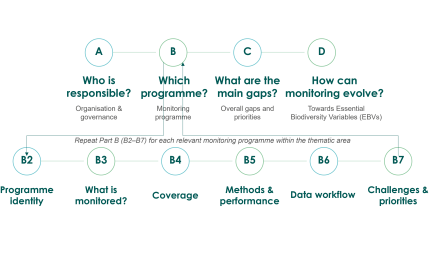
In brief: Part A is completed once per organisation. Part B is programme-based and can be completed several times to describe different monitoring programmes. Part C provides an overall synthesis across the programmes described, while Part D on Essential Biodiversity Variables (EBVs) is optional.
8. How is the questionnaire structured, and which parts do I need to complete?
The questionnaire has four parts:
-
Part A – General information: completed once per organisation.
-
Part B – Monitoring-programme-based reporting: completed for each relevant monitoring programme and thematic area.
-
Part C – Synthesis, gaps and priorities: provides an overall reflection across the monitoring programmes described.
-
Part D – Essential Biodiversity Variables (EBVs): optional and intended for additional reflections on EBVs.
You will only be asked detailed questions for thematic areas that are relevant to your organisation.
9. What should I do if my organisation works on biodiversity monitoring outside the thematic areas covered by the questionnaire?
This questionnaire focuses specifically on terrestrial habitats, freshwater habitats, freshwater benthic invertebrates, marine mammals, and seagrass habitats. Detailed questions are asked only for thematic areas relevant to your organisation.
If your organisation also works on other biodiversity themes, these are outside the main scope of the questionnaire, although “Other” fields are provided in some sections where additional information may be relevant.
10. What is meant by a “monitoring programme” in this questionnaire?
The questionnaire uses monitoring programmes as the practical starting point for describing biodiversity monitoring. In this context, please report monitoring as it is operationally implemented in practice, rather than starting from individual indicators or variables.
A monitoring programme may have a defined purpose, scope, methods, variables and links to reporting or assessment processes. It does not need to be exclusively designed for biodiversity monitoring. Programmes that only partly produce biodiversity-relevant data, such as monitoring undertaken under the Water Framework Directive, can also be included.
11. Can I provide information on more than one monitoring programme within the same thematic area?
Yes. Please report different monitoring programmes separately in Part B.
Part B is programme-based and should be repeated for each relevant monitoring programme. In the survey platform, Part B is divided into separate questionnaires for each thematic area. The relevant thematic questionnaire can therefore be completed more than once when several monitoring programmes need to be reported.
The relevant questionnaire link may also be shared with the person or organisation responsible for a particular monitoring programme, where appropriate.
12. What if a monitoring programme mainly focuses on environmental status, but also produces some biodiversity data?
Yes, such a programme should be included if it produces biodiversity-relevant data. The questionnaire specifically asks respondents to also consider monitoring programmes that only partially produce biodiversity data, such as monitoring carried out under the Water Framework Directive.
For example, if a freshwater monitoring programme mainly focuses on water quality but also collects data on benthic invertebrates or habitat types, the biodiversity-related component of that programme is relevant to the questionnaire. Please describe the programme and indicate the relevant thematic area(s) and the role of the biodiversity data within the programme.
13. What if our organisation only has partial responsibility for a thematic area or monitoring programme?
Partial responsibility should also be reported. Please indicate the thematic areas for which your organisation has full or partial responsibility and, where possible, briefly describe the scope of that responsibility and your organisation’s main functions, such as data collection, aggregation or reporting.
If responsibility is shared, please also identify the other organisations contributing to the provision of data and describe their roles where possible.
What if information is incomplete or difficult to provide?
14. Do all answers need to be exact, or can we provide estimates?
Best estimates are acceptable where exact information is not available. The questionnaire explicitly allows respondents to provide best estimates and short qualitative explanations where needed.
In the section on monitoring costs, personnel effort and performance, indicative ranges and approximate values are sufficient.
15. What should we do if the requested information or documentation is not available?
Please provide the best information available. Where documentation exists, references to websites, reports, legal acts, protocols or other relevant sources are appreciated.
If an exact reference is not available, a short description can be provided where appropriate. Supporting documents that are not publicly available online may also be submitted separately by email to the questionnaire team.
16. Are links and references mandatory?
References and links are not mandatory, but they are highly recommended where available.
References are particularly useful for documenting mandates, monitoring programmes, methods, variables, indicators and data-management processes, but the questionnaire also allows short descriptions where documentation or an exact citation is not available.
Essential Biodiversity Variables (EBVs)
17. Do I need to know the EBV framework or classify our monitoring programmes according to EBVs?
No detailed knowledge or precise classification of Essential Biodiversity Variables (EBVs) is required to complete the questionnaire.
Where relevant, links between monitoring programmes and broad EBV domains may be explored to support comparison, synthesis and future interoperability analyses. Precise EBV classification is not required from respondents.
18. Is Part D on Essential Biodiversity Variables mandatory?
No. Part D is optional. It provides an opportunity to share additional information and reflections on the relevance of EBVs, barriers to their use, related variables or indicators, and possible gaps or challenges.
Practical information
19. How much time should we reserve for completing the questionnaire?
The time needed will depend on the number of thematic areas and monitoring programmes relevant to your organisation.
Initial completion may take approximately up to one hour. However, additional time may be needed for internal consultation and for compiling information from colleagues or other relevant sources. If several people contribute to the response, we recommend allowing sufficient time for internal coordination before submitting the questionnaire.
23. Where can I get help with completing the questionnaire?
If you have questions about the questionnaire or need technical assistance, please contact the EBOCC questionnaire team at ebocc.questionnaire@syke.fi