Phase I: FEO Project 2020-2024
In the Finnish Ecosystem Observatory project (FEO, 2020–2024), the current state of biodiversity and ecosystem monitoring in Finland was assessed. The project investigated the use of monitoring methods based on field observations, remote sensing, eDNA, and other molecular biological methods, as well as modeling, and assessed their future potential.
To improve the availability, findability, and interoperability of nature data, the Finnish Nature Information Hub (luontotieto.syke.fi) was created, where comprehensive information on nature and habitat types can be found. The new website also offers an overview of Finland's biodiversity and ecosystem monitoring, as well as other data-aggregating online services, such as the updated and automated state of nature indicators and the Red List of Habitats online service, which compiles habitat threat assessments into digital form.
Supported by the FEO project, the national coordination group for nature information, Lukki (luontotieto.syke.fi), was established. Its goal is to promote the national nature information development program for 2024–2035. This collaboration model between nature information producers and users supports the extensive monitoring, assessment, and research of habitats, as well as the management of related data.
Phase II: Launch of the FEO RI Nature Data Infrastructure 2025
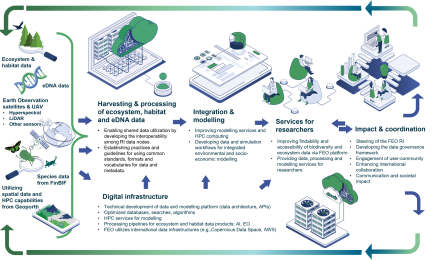
Under the leadership of Syke and Luke, the development work for building a national nature data infrastructure has continued based on the FEO project. The planned activities of FEO RI are illustrated in Figure 1. The goal of further development is to build a digital research and monitoring infrastructure that supports both research and societal decision-making, serving as a unifying service to facilitate the findability and usability of various nature datasets. Examples of datasets accessible through FEO RI include: i) information on the occurrence and condition of habitat types, ii) information on natural resources and ecosystem services, and iii) molecular biological observations.
The development targets of FEO RI are divided into three categories:
- Comprehensive adoption of new cost-effective methods that support and complement monitoring as a source of habitat and ecosystem information, including remote sensing, molecular biological methods, machine learning, and modeling.
- Building an interoperable infrastructure that enables comprehensive data production and management, based on existing services and allowing for necessary new services and data products.
- Creating common operational models and practices for the production, management, and distribution of data.
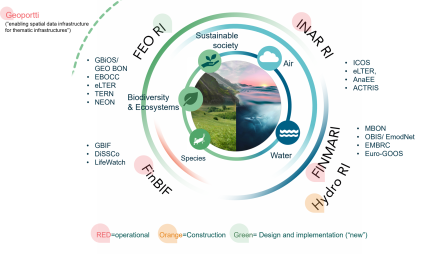
FEO RI complements the services provided by other national research infrastructures in terms of spatially comprehensive data products and analysis services that promote societal sustainability (Figure 2). The long-term goal is to develop the nature data infrastructure in collaboration with emerging international infrastructures (e.g., GBiOS, EBOCC) and to establish FEO RI's position among national research infrastructures.
Additional information:
Research professor Petteri Vihervaara, Syke (forename.lastname@syke.fi)
Research professor Mikko Peltoniemi, Luke (forename.lastname@luke.fi)