Finnish National IPBES working group brings experts together

Tasks of the working group are to:
- act as a national network for IPBES
- participate in formulating positions and views to IPBES reports processes
- participate in preparation of participation to IPBES plenaries
- promote and disseminate IPBES work and results in Finland
- promote the participation of Finnish experts in IPBES work.
Additionally, members of the working group act as contact points to their ministries, universities, and expert/research institutes.
From June 2023, the working group is chaired by Leif Schulman, Director General of the Finnish Environment Institute. The secretariat of the Group is located at the Finnish Environment Institute. Eeva Primmer, Research Director of the Finnish Environment Institute, was elected to the IPBES Bureau at the IPBES 10 Plenary meeting in 2023 for the term of office lasting three sessions.
Members of the working group
Please find the working group members here (in Finnish).
Intergovernmental Science-Policy Platform on Biodiversity and Ecosystem Services (IPBES)
The Intergovernmental Science-Policy Platform on Biodiversity and Ecosystem Services (IPBES) is an independent intergovernmental body established by States to strengthen the science-policy interface for biodiversity and ecosystem services for the conservation and sustainable use of biodiversity, long-term human well-being and sustainable development.
IPBES was established in Panama City, on 21 April 2012 by 94 Governments. It is not a United Nations body. However, at the request of the IPBES Plenary and with the authorization of the UNEP Governing Council in 2013, the United Nations Environment Programme (UNEP) provides secretariat services to IPBES.
Currently, 146 countries are members of IPBES. The contact point for Finland is the Ministry of the Environment, and the National Focal Point is Suvi Borgström, Senior specialist.
Work of IPBES can be grouped into four complementary areas:
-
Assessments: On specific themes, methodological issues, and at both the regional and global levels.
-
Policy Support: Identifying policy-relevant tools and methodologies, facilitating their use, and catalysing their further development.
-
Building Capacity & Knowledge: Identifying and meeting the priority capacity, knowledge and data needs of our member States, experts and stakeholders.
-
Communications & Outreach: Ensuring the widest reach and impact of IPBES work.
Assessment reports
IPBES produces regular and timely assessments of knowledge on biodiversity and ecosystem services and their interlinkages, which include comprehensive thematic, global and regional assessments. The assessment processes involve a large number of internationally recognised experts.
Ongoing IPBES assessment reports
- Methodological Assessment of the Impact and Dependence of Business on Biodiversity and Nature’s Contributions to People (Business and biodiversity assessment, ipbes.net)
- The second global assessment of biodiversity and ecosystem services (Second global assessment, ipbes.net)
- The methodological assessment on monitoring biodiversity and nature’s contributions to people (Monitoring assessment, ipbes.net)
- Methodological assessment of integrated biodiversity-inclusive spatial planning and ecological connectivity (Spatial planning and connectivity assessment, ipbes.net)
Recently completed IPBES assessments:
- Thematic assessment of the interlinkages among biodiversity, water, food and health (Nexus assessment, ipbes.net)
- Thematic assessment of the underlying causes of biodiversity loss, determinants of transformative change and options for achieving the 2050 vision for biodiversity (Transformative change assessment, ipbes.net)
- Thematic Assessment Report on Invasive Alien Species and their Control (Invasive alien species assessment, ipbes.net)
- Thematic assessment of the sustainable use of wild species (Sustainable use of wild species assessment, ipbes.net)
- Methodological assessment regarding the diverse conceptualization of multiple values of nature and its benefits, including biodiversity and ecosystem functions and services (Values assessment, ipbes.net)
The IPBES assessment process
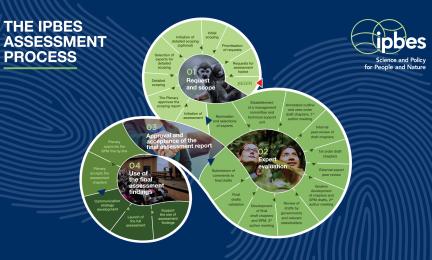
Guidelines have been developed for the experts working on the assessment reports to support their work and promote consistency within the reports. An indicative timeline up to 2030 for ongoing and future IPBES assessments is available at the IPBES website.