Project description
Background and Scope
In Finland, reporting responsibilities of the United Nations Sustainable Development Goals indicators of the 2030 Agenda for Sustainable Development have been delegated to several National Statistics Institutes, and Statistics Finland acts as the national coordinator and focal point towards UN. Finnish Environment Institute (Syke) has agreed responsibility in total of 26 indicators under its domain of expertise.
Before the project started, several SDG indicators remained unreported because of lacking source data and absence or incompleteness of the processing pipelines and reusable solutions. Calculation of some indicators required considerable manual work, which was laborious and costly. Automating some or all of these steps would bring considerable savings, enhance processing transparency and repeatability, and also improve the quality of previously calculated indicator time series. For many previously reported SDGs, quality improvements in terms of spatial and temporal coverage could be achieved by utilization of Earth Observation data.
Objectives
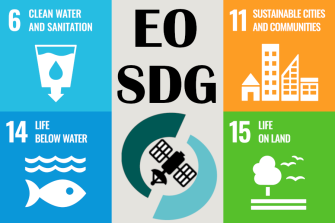
The project aimed to strengthen the capacity of Syke (and Finland) to answer the monitoring and reporting needs of the UN Agenda 2030 and its SDGs. This was done by refining the indicator processing pipelines to increase cost-efficiency and reusability, together with focusing on leveraging the full potential of analysis-ready multi-source geospatial data. Total of 6 SDG indicators, falling under goals 6 (Clean water and sanitation), 11 (Sustainable cities and communities), 14 (Life below water) and 15 (Life on land) were pre-selected for further testing and development in the project:
- SDG 6.3.2 Proportion of bodies of water with good ambient water quality
- SDG 6.6.1 Change in the extent of water related ecosystems over time
- SDG 11.3.1 Ratio of land consumption rate to population growth rate
- SDG 14.1.1a Index of coastal eutrophication
- SDG 15.3.1 Proportion of land that is degraded over total land area
- SDG 15.4.2 Mountain green cover index
Summary of SDG indicator development
The EOSDG project was implemented in two phases, both running for 12 months. In the first one, a “Proof-of-Concept” (PoC) approach was taken, aiming to demonstrate the practical potential and suitability of selected input data and methodology to calculate SDG indicators with a reasonable level of confidence, without needing to fully develop the processing pipelines. Six SDG indicators were piloted in the PoC, which comprised of two tasks. First, the suitability of currently used and new input analysis-ready data sources was assessed, applying the data quality criteria of Statistic Finland. In the second task, calculation methods of these indicators were piloted to gather evidence of feasibility for full national implementation and automation of processing pipelines, work foreseen to be done in the second year.
At the end of the PoC phase, the SDG indicator leads together with the project steering group decided which piloted indicators were mature enough to continue for full implementation, the second phase of the EOSDG project. This decision was made as a balance between the technical evidence of feasibility provided, and cost-effectiveness of the implementation. Four SDG indicators (6.3.2, 6.6.1, 14.1.1a and 15.3.1) were accepted for full implementation, and two indicators, 11.3.1 and 15.4.2, remained in the PoC phase. SDG 11.3.1 could not be advanced due to lack of suitable data, but reasonable results were achieved for SDG 15.4.2 and these were used for national reporting.
In the second year, the “Implementation” phase, focus shifted from limited pilot studies to full country implementation, evaluation and reporting. Implementation consisted of four tasks: automation of the indicator processing pipelines, computation of the SDG indicator (and sub-indicators), evaluation of results, and publishing / reporting the final and evaluated SDG indicators to Statistics Finland SDG database (link).
Results
A summary table of the findings of the six SDG indicators is shown below.
SDG summary table (pdf, 119.74 KB)Deliverables and Resources
- Interim Progress Report, link (coming soon)
- Methodological Report, link (coming soon)
- Full time-series of national SDG indicators: StatFin SDG database (link).
Two GitHub repositories have been published to increase FAIRness (findability, accessibility, interoperability and reusability) and transparency of the developed workflows / processing pipelines. These repositories are free and open for any interested country, National Statistical Institute or individual to examine, take into use, modify or suggest improvements. These are:
- Analysis tools supporting Finland’s groundwater-related ecosystem assessment (SDG 6.6.1). It integrates Syke’s WSFS-O hydrological model simulations with GRACE/GRACE-FO satellite-based total water storage observations. The repository provides a transparent and reproducible workflow for evaluating groundwater storage variability, long-term trends, and satellite–model consistency. Two dashboards are also available for groundwater trend analysis and satellite data validation. See chapter 3 of the methodological report for detailed description of the methodology. Link: https://github.com/sykefi/sdg661-groundwater-finland
- A repository containing example workflow for nationally adapted SDG 15.3.1 Sub-indicator (Land productivity) calculation from custom Landsat timeseries dataset. See chapter 6 of the methodological report for detailed description of the methodology. Link: https://github.com/sykefi/sdg1531-land-productivity-finland
This work was funded by the European Union through Eurostat SMP Action Grants (SMP-ESS-2023-GEOS-IBA-REGIO, Project Number 101155917).
Funded by the European Union. Views and opinions expressed are however those of the author(s) only and do not necessarily reflect those of the European Union or Eurostat. Neither the European Union nor the granting authority can be held responsible for them.