Background
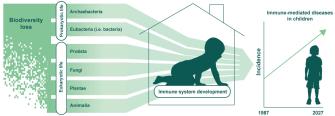
In the five-year RESIDENTS project funded by the European Research Council (ERC), we investigate whether biodiversity is associated with children's health. Nature and green environments are known to promote human health in various ways. Previous research suggests that bacteria and microscopic fungi found in natural and green environments support the normal development of the immune system in infants and children, as well as their later health. However, infants and children also encounter many other organisms. In the RESIDENTS project, we are interested in whether organisms from all six kingdoms of life are relevant to immune system development and children's health.
Biodiversity is declining at an unprecedented rate. This decline has been rapid for several decades. In the RESIDENTS project, we examine whether changes in biodiversity in Finland over the past 40 years are associated with the health of Finnish children.
In the RESIDENTS project, we utilise the latest molecular biology methods, such as environmental DNA-based biodiversity monitoring and longitudinal immune profiling based on proteomics. We also make use of Finland’s internationally unique registry data and observational datasets based on charismatic species.
Research Questions
The RESIDENTS project addresses the following questions:
- What types of biodiversity are people exposed to in their everyday environments, such as homes and yards?
- Is species composition of homes associated with the development of infants’ immune system?
- Is biodiversity loss over recent decades associated with children’s risk of developing immune-mediated diseases?
Substudies
The RESIDENTS project consists of three substudies:
- In the first substudy, we investigate the species found in people’s homes and yards, and whether the biodiversity of yards or nearby areas influences the species detected indoors. We also examine how various factors, such as season, housing type, and lifestyle, affect indoor species composition.
- In the second substudy, we examine how the species composition of homes is associated with the development of infants’ immune system during the first year of life. We repeatedly measure the biodiversity of children’s home environments and analyse proteins and cells indicative of immune system function.
- In the third substudy, we investigate whether the species observed in nearby environments or long-term changes in biodiversity are associated with children's risk of developing immune-mediated diseases. This substudy covers a period of four decades.
Impact
The methods used in the project allow us to study the positive and negative effects of different organisms on human health with unprecedented precision. We therefore expect the project to generate new insights into the importance of other species for human health.
Muita tutkimuksia
Contact information
Principal researcher Jenni Lehtimäki, Finnish Environment Institute (Syke), forename.lastname@syke.fi, tel. +358 503 050 007
Senior research scientist Mira Grönroos, Finnish Environment Institute (Syke), forename.lastname@syke.fi, tel. +358 504 724 958