Threats and opportunities of biodegradable plastics – recommendations for the decision makers

We published seven action recommendations for decision-makers regarding biodegradable plastics. These take into account factors such as Finland’s environmental conditions affecting degradation, and provide guidance on reforming standards and certification systems. Incorporating northern conditions into standards also opens up opportunities for Finnish research and innovation.
Action recommendations for the decision makers:
-
In Finnish conditions, plastic recycling may be a better option than biodegradability. Biodegradable plastics should only be used in applications where biodegradability is beneficial and when the material cannot be recycled.
-
When biodegradable plastics are used, they must be able to degrade efficiently and completely at the end of their lifecycle. Otherwise, they must be recyclable along with other plastic waste.
-
Biodegradable plastics must degrade in the environment where they end up.
-
Standards for material biodegradability should be updated, and a mandatory EU-level certification system should be established. This would ensure that products meet strict biodegradability requirements and that products and packaging are clearly labeled.
-
The certificates and biodegradability standards must be verified under Finland’s cold conditions. Taking northern conditions into account in standards also opens opportunities for Finnish research and innovation.
-
Transparency regarding the composition and additives of biodegradable plastics must be increased in the production of plastics. Biodegradability should be taken into account in the development of life cycle assessments for packaging and products.
-
Regulations promoting chemical safety must better address the chemicals contained in biodegradable plastics, to prevent the release of harmful and persistent substances into the environment when the plastics degrade.
Biodegradable or bio-based?
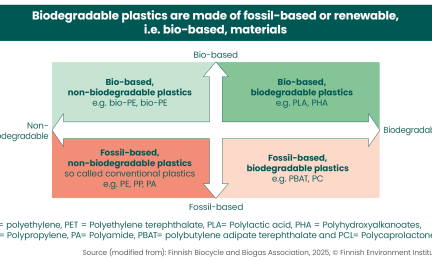
Biodegradable plastics are sometimes confused with bio-based plastics. Bio-based plastics are made of renewable raw materials, but not all bio-based plastics are biodegradable. All plastics that end up in the environment become fragile due to sunlight and temperature changes and thus become sources of microplastics.
The EU Packaging and Packaging Waste Regulation refers to both aerobic and anaerobic degradation as composting.
Classification of biodegradable and bio-based plastics
Case: Biodegradability of plastics in water
Research on the biodegradability of plastics in aquatic ecosystems is currently focused on the marine environment. The general criterion for marine biodegradability is determined within two years or faster than comparable standard materials. These criteria have been defined only for seawater and do not take into account northern conditions, where water freezes in winter.
A research study by a Finnish research group found that the decomposition of plastics is influenced by the structure of the microbial community, water temperature, nutrients, humus content, and salinity.
The University of Jyväskylä studied in the PlastLIFE project the degradability of various biodegradable plastics in lake water and Baltic Sea water using two different methods. Differences were observed in the degradation of plastics in lake water and Baltic Sea water, but the different methods also yielded varying results. The study highlights the different behaviors and fates of plastics in fresh water and brackish water, as well as the impact of the chosen method on the research results. Additionally, current standard methods do not account for Finland’s four seasons. According to the study, degradation at summer temperatures is three times faster than in autumn, winter, or spring in the boreal zone.
Read more
In the newly published policy recommendations, we explore the threats and opportunities of biodegradable plastics and share insights from our research on their degradability in soil, water, and recycling facilities.