Comprehensive security is founded on a good state of the environment

-
Environment and nature must be firmly integrated into comprehensive security models in Finland and elsewhere through concrete actions and by strengthening expertise across the security sector.
-
Security threats arising from environmental crises should be addressed through policy measures that advance sustainability transformations.
The same investments can create new business opportunities while promoting human wellbeing, societal stability and peace.
-
Knowledge base on the state of the environment must be strengthened.
Knowledge-based solutions that enable better preparedness for threats should be developed in cooperation with different actors.
-
It is important to seek synergies between defence investments and the environment.
Projects that strengthen national defence can simultaneously promote environmental monitoring, ecosystem restoration and protection, as well as climate change mitigation and adaptation.
Sustainable security is built on considering the environment and nature
Environmental, social and economic sustainability are directly linked to the security of societies and individuals. Sustainability transformation, meaning the rapid alignment of societal functions within the limits of nature’s capacity, also improves comprehensive security. The transformation concerns, for example, housing, mobility, and energy, food and industrial production systems.
Security is about managing risks and enabling wellbeing
Security can be understood in different ways. ‘Hard’ security is focused on threats and preparedness, typically managed by states and international organisations. Its key components include military defence, security of supply, the prevention of large-scale environmental risks, emergency services and police. ‘Soft’ or ‘positive’ security emphasises the wellbeing of individuals and communities, communal action, justice, resilience, and ‘freedom from insecurity’.2 The welfare state, local communities and nature-positive actions have an important role in advancing it. Hard and soft security are not mutually exclusive. A sustainable environment and nature
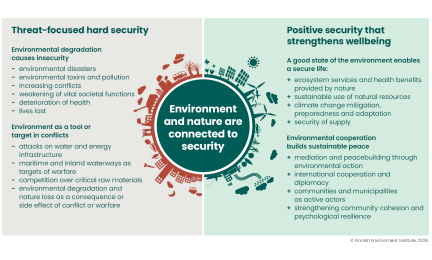
Security is built near and far
At the global level, geopolitical instability is eroding the rules-based international system and the consideration of environmental issues. At the current rate of development, many critical thresholds, or tipping points, of the Earth System are likely to be crossed in the coming decades. This poses direct and indirect security threats to climate, nature, society and security of supply (e.g. changes in North Atlantic Ocean currents and the drying of the Amazon rainforest).4
In Finland’s neighbouring regions, geopolitical tensions increase risks such as oil spills in the Baltic Sea. Increased military training in the European Arctic may cause environmental degradation.
The current geopolitical situation highlights the importance of defending Finland’s eastern border. Hence, resources previously allocated to advancing sustainability transformation are partly being redirected to defence. At the same time, ecosystem restoration and dual-use technologies can create positive synergies between
defence and the environment.
At national and local levels, environmental degradation is directly reflected in weakened economic security, when raw materials become more expensive and harder to obtain. Environmental pollution decreases the quality of living environments and human wellbeing and may also lead to local conflicts. In turn, community-based environmental action can shape values and strengthen communities’ capacity to cope with crises.
Resilience means adaptation and transformation
Alongside the concept of security, resilience is used to describe the ability of societies, individuals, and technical and ecological systems to withstand crises. In an environmental context, resilience refers to the ability of the Earth System to endure stress and recover from it, maintain its core functions and provide ecosystem services. The resilience of the Earth System is a prerequisite for the resilience of societies and individuals that may in turn need to adapt or transform their practices to enable the resilience of the natural systems.3

Leadership
Environmental administration should be given a stronger role in the management and coordination of comprehensive security. At present, leadership in climate and environmental security is not coordinated. Long-term advancement of comprehensive security requires continuity management, including sufficient resources for environmental administration and monitoring.
Finland’s Security Strategy for Society emphasises cross-sectoral coordination at the state level, but cooperation is also essential regionally and locally. Research, local knowledge and Sámi traditional knowledge concerning the environment are important for situational awareness, risk assessment and governance at the regional level.
International and EU activities
Building security is a cross-border, networked endeavour. Cooperation for the environment – such as the UN Sustainable Development Goals, international climate agreements and water diplomacy – helps maintain peace. Finland has already established an international profile in this area, and further opportunities for leadership are offered by NATO, the EU, and Nordic and Arctic cooperation.International environmental research, innovation, knowledge exchange and learning form a key foundation for cooperation. In addition, it is essential to recognise dependencies and environmental impacts arising from global supply chains and to develop sustainable and fair solutions to manage them.
Defence capability
Changes in the operating context caused by climate change, such as wet winters and hot summers, affect defence capability. The energy transition, particularly the shift from fossil fuels to electricity, also impacts the defence sector, which is more dependent on oil than the rest of society.6 Innovation at the intersection of environment and defence can provide synergies.
Ecosystem restoration can enhance border security; for example, restoring areas along Finland’s eastern border to a natural state makes terrain more difficult to traverse. Military exercises can also have negative impacts on nature and the climate. These impacts must be minimised, particularly in the delicate Arctic environment, while safeguarding the living conditions of local communities.
Internal security
Sustainability transformations affect individuals and communities in different ways. They may face resistance, potentially leading to conflict. Alternatively, for example, energy transitions can empower individuals and communities as active energy citizens, increasing their sense of security. Achieving positive outcomes requires involving citizens in decision-making and compensating for negative impacts – both essential for maintaining social cohesion.
Local environmental action also helps prevent social exclusion. Climate change impacts elsewhere in the world also affect countries’ internal security, for example through climate-induced migration.
Economy, infrastructure and security of supply
The economy, infrastructure and security of supply depend on natural resources, the availability and quality of which are declining. Global supply chains are increasingly exposed to disruptions caused by climate change, ecosystem degradation and environmental disasters.7 Environmental changes are already affecting global financial and insurance systems.
Increased flooding and drought, as well as pollution, pose risks to critical infrastructure such as energy, transport, telecommunications, water supply and food production.8 Risks associated with oil accidents threaten the marine environment and maritime traffic.
Public authorities and businesses must reassess risks and direct investments towards energy-efficient, circular and nature-positive infrastructure, supply chains and business models. Traditional environmental risk management (e.g. dealing with flood risks, contaminated land, toxic wastes) is expanding to new challenges as climate change, water pollution and biodiversity loss progress. This requires new and more systematic foresight and preparedness, and more active cooperation across sectors and internationally.
Functional capacity of the population and services
Security depends on the capabilities of people and communities. Education in nature, environment and democracy issues, critical literacy and conflict management skills support social cohesion and enable active participation. Reliable and accessible research-based knowledge is needed on how to improve environmental conditions, enhance security and address risks at their root causes.
Psychological resilience
Biodiverse nature is part of Finnish culture. It provides recreation and food, such as berries, mushrooms and fish. The Sámi relationship with nature offers valuable lessons, emphasising respect and a living connection in which humans are part of nature rather than above it. Access to nature and opportunities for active, collective environmental action are essential for mental wellbeing and resilience. A clean environment, safe surroundings and sustainable use of natural resources are critical not only for psychological resilience but also for physical
wellbeing.
Collaboration is needed to advance sustainability transformation and security together
Concrete actions and investments to advance sustainability transformations and protect the environment generate benefits from the perspective of comprehensive security. Sustainability transformations can also improve environmental health and create competitiveness gains. Public authorities should actively encourage closer cooperation and coordination among different actors, including environmental administrations, research institutes, defence forces, emergency supply agencies, private companies, and civil society.
Comprehensive security is founded on a good state of the environment
Authors
Paula Kivimaa, Suvi Sojamo, Lauri Ahopelto, Maija Faehnle, Maria Kopsakangas-Savolainen, Johan Munck af Rosenschöld, Jyri Mustajoki, Sampo Pihlainen, Marja Helena Sivonen, Isabell Storsjö, Kari-Matti Vuori