WSFS-Vemala

The WSFS-Vemala (also Vemala) model simulates nutrient gross load, retention and net load from Finnish watersheds to the Baltic Sea. It includes two main sub-models, the WSFS hydrological model (Vehviläinen 1994) and the Vemala water quality model (Huttunen et al. 2016). The model has been developed through the years and the development of model versions leads to a more process-based nutrient loading model. WSFS-Vemala is part of the Watershed simulation and forecasting system of Finnish Environment Institute Syke (WSFS webpage).
-
200 000+lakes and rivers in model
-
10+different substances
-
40+organisations using
-
20+years of model development
Vemala model outputs enable assessing various aspects of nutrient loading:
- different substances, such as phosphorus, nitrogen and their fractions
- load to different waterbodies including lakes, rivers and coastal waterbodies
- load from different areas, ranging from small catchments to Baltic Sea regions
- contribution of different loading sources
- daily, seasonal and annual variations in loading
- changes over time
- scenarios describing the impact of different management measures and climate change
Vemala services
Services produced with Vemala model include open data sets, outputs with limited access/fee and paid modelling services. Users can access Vemala simulation outputs which are produced centrally by the Finnish Environment Institute (Syke) in the modelling environment of the Watershed simulation and forecasting system WSFS.
Paid services and projects
- User interface for expert use accessible for an annual fee (includes sVemala)
- Paid data inquiries
- Commercial modelling services
- Research and other projects (model applications, model development and collaboration), examples of Vemala projects
Simulation tool sVemala
Simulation tool sVemala is a nutrient loading simulation tool based on Vemala model results. Excel-based sVemala is developed to provide the possibility to use Vemala model results independently and to assess the effect of nutrient loading changes on a catchment scale. sVemala contains annual loading, retention and source apportionment of the nitrogen, phosphorus and suspended solids loading to each river stretch and lake simulated in Vemala model. sVemala can be used to assess how the changes in nutrient loading affect nutrient concentrations in downstream lakes and river stretches as well as the loading on catchment level. sVemala also includes loading scenarios with different combinations of climate change and water management practices simulated with the Vemala model.
sVemala contents:
- Calculation of nutrient transport: loading, retention and source apportionment of nitrogen, phosphorus and suspended solids loading to each river stretch and lake
- Changes in loading: user assigns a change in loading for a river stretch or lake (kg/year)
- Summary for each lake/river: summary of the loading to the chosen waterbody and the division to different sources
- Areal loadings: calculation produces areal loading sums
- Instructions: instructions for the use of sVemala and information about inputs and processes of Vemala model
Simulation tool sVemala is for expert use and available via the Vemala user interface for an annual fee.
Retention pool calculations
Retention pool studies are an example of paid modelling services Syke provides. The method developed in Syke is used to identify possible locations for retention pools in a specific study catchment. Subsequently, the impacts of these potential retention pools on flood management, low flows and nutrient retention are then estimated using Vemala model.
- Identifying possible retention pool locations with a spatial analysis method
- Simulating impact of retention pools with Vemala model
Impact of Vemala
Three main long-term impacts of Vemala model were identified in an impact pathway analysis of the model. This analysis was conducted by Gaia Consuling Oy in 2024 as part of the impact assessment of Syke's operations.
-
Strengthening ecological sustainability and societal well-being
-
Improved status of waterbodies
-
Improved allocation and efficiency of water management actions
Impact pathway analysis of WSFS-Vemala model
The long-term impact of WSFS-Vemala model and how it is created: impact pathway analysis describes the Vemala upkeeping and development work via the resources used, activities performed, outputs of activities, outcomes and impact. Impact assessment of Syke's operations was done by Gaia Consuling Oy 2024 and it included an impact pathway analysis of WSFS-Vemala model.
News in Finnish: Suomen ympäristökeskus saavutti tulossopimuksen vaikuttavuustavoitteet (Gaia Consuling Oy, Syken vaikuttavuuden arviointi 2024)
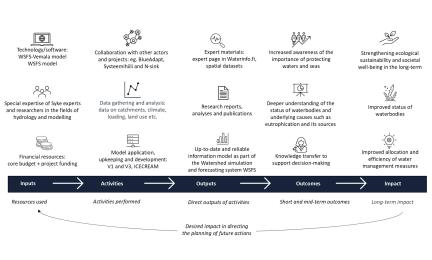
(© Gaia Consuling Oy 2024, Impact assessment of Syke's operations)
Resources: modelling system WSFS & expertise of Syke experts and researchers & financial resources
Activities: collaboration & data gathering and analysis & model application, upkeeping and development
Outputs: expert materials & reports and publications & up-to-date and reliable modelling system WSFS
Outcomes: increased awareness & deeper understanding & knowledge transfer to decision-making
Impact: strengthening of ecological sustainability and societal wellbeing & improved status of waterbodies
& improved allocation and efficiency of water management actions
(unofficial translation, original report in Finnish)
Eutrophication, nutrient loads and water management
- What causes eutrophication? (waterinfo.fi)
- High nutrient load fuels eutrophication - estimates from Vemala model (ymparisto.fi)
- Water resources management requires planning (waterinfo.fi)
- Many opportunities for the protection of waters and the Baltic Sea (ymparisto.fi)
- The future of the water quality and eutrophication status of Finnish coastal waters, and assessing it (report abstract available in English)
Vemala and submodels
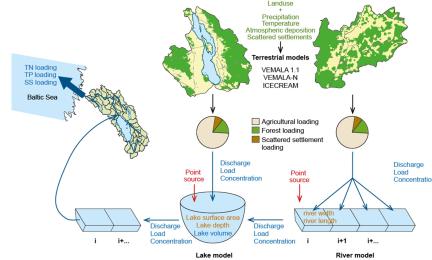
The Vemala model versions V1 and V3 are in operational use simulating nutrients and processes on a daily-time-step. Furthermore, the Vemala model consists of multiple submodels. The Vemala versions and submodels are described in the following sections.
Vemala model versions V1 and V3
The table below describes the operational model versions V1 and V3 of Vemala. In version V1, nutrients are represented as total nutrients (total nitrogen and total phosphorus), whereas in version V3, nutrient fractions are also provided separately. The open spatial data of Vemala has been produced using model version V1.
| V1 | V3 | |
|---|---|---|
| SUBSTANCE | TP, TN, SS, TOC | TP, TN, SS, TOC, PO43-, PP, Porg, NO3-, NH4+, Norg, phytoplankton, O2 |
| HYDROLOGICAL MODEL | WSFS | WSFS |
|
TERRESTRIAL MODEL (agricultural areas) |
VEMALA-ICECREAM concentration-runoff relationship (SS) partly process-based simulation of terrestrial C processes (TOC) |
VEMALA-ICECREAM concentration-runoff relationship (SS) partly process-based simulation of terrestrial C processes (TOC) |
|
TERRESTRIAL MODEL (other land areas) |
concentration-runoff relationship, partly process-based simulation of terrestrial C processes (TOC) |
concentration-runoff relationship, partly process-based simulation of terrestrial C processes (TOC) |
| RIVER MODEL | nutrient transport model | biogeochemical model |
| LAKE MODEL | nutrient mass balance model | biogeochemical model |
Vemala V3
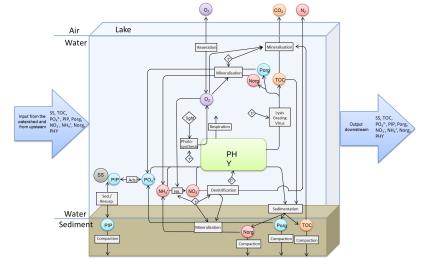
Vemala V3 model uses terrestrial input simulated with different Vemala submodels as is summarized in table above. In rivers and lakes, the phytoplankton growth is simulated using the AQUAPHY model (Lancelot et al. 1991) and the nutrient cycling using a simplified version of the biogeochemical model RIVE (Billen et al., 1994). The bioavailable nutrients are linked in the aquatic ecosystem to one another through phytoplankton dynamics, organic matter degradation and sedimentation.
Vemala V3 can simulate the loads of total and bioavailable nutrients (NO3- and PO43-) to the sea with the contribution of the different loading sources. Furthermore, the model describes the impact of different farming actions, management measures and climate change on the nutrient loads.
More information about Vemala V3:
Korppoo ym. 2017 (sciencedirect.com)
Korppoo et al. 2026 (hess.copernicus.org)
Vemala-N
Vemala-N simulates nitrate (NO3-), organic nitrogen (Norg) and total nitrogen (TN) leaching and load formation at a catchment scale. The simulation unit is crop/land use class with 5 agricultural crop classes and one forest class. The model simulates the dependency of the main processes (mineralisation, nitrification, denitrification, plant uptake) on the soil moisture and temperature. Vemala-N can be used to run scenarios to simulate the effect of a changing climate on the nitrate leaching and its sub-processes or the effect of changing crops and fertilisation (both mineral and organic) on the nitrate leaching. The results form the VEMALA-N sub-model and the forest loading for P are then adjusted to the Metsävesi results (Metsävesi, 2020).
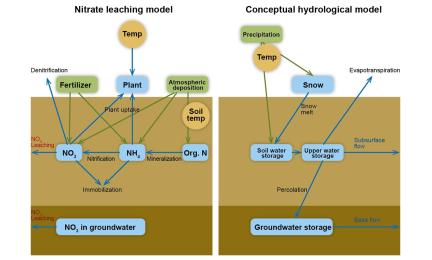
More information about the model: Huttunen ym. 2015 (researchgate.net)
Vemala-ICECREAM-P
Vemala-ICECREAM simulates particle bound and dissolved phosphorus (PP and DP) load and erosion from agricultural areas. It is a field-scale, process based model (e.g. Jaakkola et al. 2012), applied to all fields in Finland. The field characteristics – soil type (clay, silt, coarse and peat), field slope and the size of a rectangle-shaped field plot – are used in the simulations. The output from the ICECREAM model (daily total P load) is used as an input to the Vemala model. Agricultural measures that are taken into account in ICECREAM and can be used in management scenarios are:
- Amount, depth of application and type of fertilizer (mineral/manure)
- Annual crops (also over winter), perennials and root crops, 13 different crops parameterized
- Conventional tillage, direct sowing
- Dates for agricultural practices
- Buffer zones/strips
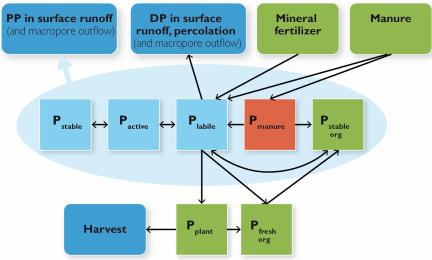
More information about the model: Huttunen ym. 2015 (researchgate.net)
Vemala-ICECREAM-N
Process-based N simulation in ICECREAM is based on the GLEAMS model (Knisel, 1993). ICECREAM simulates the daily balance of organic matter, organic N, ammonium nitrogen (NH4-N) and nitrate nitrogen (NO3-N) pools by accounting for input of plant residues, organic and mineral fertilizer, atmospheric deposition, fixation by plants and decay of organic matter. Processes reducing N in the soil are plant uptake, denitrification, volatilization and transport with runoff and leaching. ICECREAM application on each field provides the total agricultural loading of N fractions (TN, organic N, NH4-N and NO3-N) as input to the Vemala model for catchment scale loading simulations.
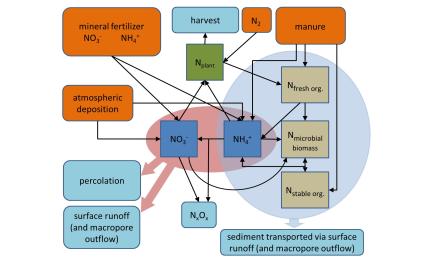
More information about the model and more detailed description of the model structure (picture 2): Kämäri ym. 2019 (sciencedirect.com)
Vemala TOC
Vemala TOC model simulates TOC processes in the soils. TOC leaching depends on the C storage, soil moisture, temperature and runoff conditions. C in soil is described with three storages – solid organic carbon (SOC), dissolved organic carbon (DOC) and dissolved inorganic carbon (DIC). The main processes described in the model are mineralization of organic carbon (OC), dissociation of OC and production of DOC, association of DOC back into SOC. Model simulates TOC leaching from 6 land use classes in the model: agriculture on clay soils, agriculture on coarse soils, agriculture on peat soils, forests on mineral soils, forests on ditched peat soils and natural peatlands. TOC and carbon modelling with Vemala are being further developed in ongoing projects.
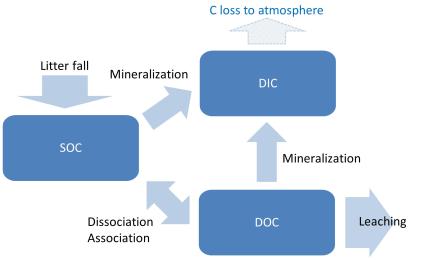
More information about TOC model: Korppoo et al. 2026 (hess.copernicus.org)
More information about Vemala
References
Billen G., Garnier J. & Hanset P. 1994. Modelling phytoplankton development in whole drainage network: the RIVERSTRAHLER Model applied to the Seine river system. Hydrobiologia, 289, 119-137.
Finér L., Lepistö A., Karlsson K., Räike A., Tattari S., Huttunen M., Härkönen L., Joensuu S., Kortelainen P., Mattsson T., Piirainen S., Sarkkola S., Sallantaus T. & Ukonmaanaho L. 2020. Metsistä ja soilta tuleva vesistökuormitus 2020. MetsäVesihankkeen loppuraportti. Valtioneuvoston selvitys- ja tutkimustoiminnan julkaisusarja 2020:6. Valtioneuvoston kanslia. http://urn.fi/URN:ISBN:978-952-287-826-7
Huttunen, I., Lehtonen, H., Huttunen, M., Piirainen, V., Korppoo, M., Veijalainen, N., Viitasalo, M., Vehviläinen, B. 2015. Effects of climate change and agricultural adaptation on nutrient loading from Finnish catchments to the Baltic Sea. Science of The Total Environment. Volume 529, 168-181. https://doi.org/10.1016/j.scitotenv.2015.05.055
Huttunen, I., Huttunen, M., Piirainen, V., Korppoo, M., Lepistö, A., Räike, A., Tattari, S., Vehviläinen, B., 2016. A national scale nutrient loading model for Finnish watersheds – VEMALA. Environmental Modelling and Assessment 21(1), 83–109. DOI: 10.1007/s10666-015-9470-6 https://doi.org/10.1007/s10666-015-9470-6
Huttunen, I., Huttunen, M., Salo, T., Mattila, P., Maanavilja, L., & Silfver, T. 2023. National-scale nitrogen loading from the Finnish agricultural fields has decreased since the 1990s. Agricultural and Food Science, 32(3), 112–127. https://doi.org/10.23986/afsci.125385
Jaakkola, E., Tattari, S., Ekholm, P., Pietola, L., Posch, M. & Bärlund, I. 2012. Simulated effects of gypsum amendment on phosphorus losses from agricultural soils. Agricultural and Food Science 21: 292–306. https://doi.org/10.23986/afsci.6773
Korppoo, M., Huttunen, I., Huttunen, M., Narikka, M., Silander, J., Jilbert, T., Forsius, M., Kortelainen, P., Kotamäki, N., Uvo, C., and Ronkanen, A.-K. 2026. Simulating carbon fluxes in boreal catchments: WSFS-Vemala model development and key insights. Hydrology and Earth System Sciences, 30, 3095–3119. https://doi.org/10.5194/hess-30-3095-2026
Korppoo, M., Huttunen, M., Huttunen, I., Piirainen, V., Vehviläinen, B., 2017. Simulation of bioavailable phosphorus and nitrogen loading in an agricultural river basin in Finland using VEMALA v.3. Journal of Hydrology, 549, 363–373. http://doi.org/10.1016/j.jhydrol.2017.03.050
Kämäri, M., Huttunen, I., Valkama, P., Huttunen, M., Korppoo, M., Tattari, S. & Lotsari, E. 2019. Modelling inter- and intra-annual variation of riverine nitrogen/nitrate losses from snowmelt-affected basins under agricultural and mixed land use captured with high-frequency monitoring. CATENA 176: 227–244. https://doi.org/10.1016/j.catena.2019.01.019
Lancelot C., Veth C. & Mathot S. 1991. Modelling ice-edge phytoplankton bloom in the Scotia-Weddell sea sector of the Southern Ocean during spring 1988. Journal of Marine Systems (2):333-346.
Lignell, R., E. Miettunen, H. Kuosa, J. Ropponen, L. Tuomi, I. Puttonen, K. Lukkari, M. Korppoo, M. Huttunen, K. Kaurila, J. Vanhatalo, F. Thingstad. Modeling how eutrophication in northern Baltic coastal zone is driven by new nutrient inputs, internal loading, and 3D hydrodynamics. 2025. Journal of Marine Systems. 249. https://doi.org/10.1016/j.jmarsys.2025.104049
Narikka, M., Virtanen, H., & Huttunen, M. 2024. WSFS-Vemala-kuormitusmallin paikkatietorajapinta valuma-aluesuunnittelun tukena. Vesitalous, 6, 15-21. (pdf)
Vehviläinen B. 1994. The watershed simulation and forecasting system in the National Board of Waters and the Environment. Publications of the Water and Environment Research Institute. National Board of Waters and the Environment, Finland No. 17.
Projects
Ongoing projects:
- ACWA LIFE: Actions for Waters from Source to Sea, project page (elinvoimakeskus.fi)
- PLURALAKES: Co-creating pathways to desirable nature futures of temperate lakes, project page (stockholmresilience.org)
- FESTiVAL: Final Ecosystem Services in Transition: a View from the Aquatic Landscape, project page (slu.se)
- VESSU-ST: Planning and development of tools for river basin management planning
- TURRI: Effects of windpower facilities on surface waterbodies in a changing climate - risk assessment and options for river basin management
- Identification of retention areas and modeling of their impacts with Vemala - the method has been developed and applied in several projects in collaboration with various ELY Centers
Finished projects:
- BlueLakes: Digitizing the Carbon Sink Potential of Boreal Lakes
- VesiVara: Security of supply of natural waters in Satakunta, project page in Finnish (pyhajarvi-instituutti.fi)
- RASI: Modeling the impacts of nutrient emissions from a fish farming facility on water bodies
- SiKaSimu: Opportunities to reduce the water impacts of pig and poultry production, project page in Finnish (luke.fi)
- Green-Digi-Basin: Green and digital transition in river basin management, project page (freshwatercompetencecentre.com)
- VESIBIO: Modelling and assessment of freshwater biodiversity loss using biological monitoring data
- BlueAdapt: Adaptive governance creates blue growth in Finland, project page (blueadapt.fi)
- KIPSI: Gypsum treatment of fields in the Archipelago Sea catchment, project page (seuranta.vaikutavesiin.fi)
- KLIVA: Water balance, ecosystem services and metal transport in a changing climate, project page in Finnish (fikliva.org)
- SysteemiHiili: Comprehensive assessment of climate measures in catchments - with system analysis towards carbon-neutral land use
- Vemala TOC model development in several projects
- KaiHali: Management and restoration of water bodies receiving mine waters
- Sulfa 2: Toimintamallit happamuuden ennakoimiseksi ja riskien hallitsemiseksi turvetuotantoalueilla
- LOHKO I & II: Developing field-scale nutrient load modelling which considers the specific characteristics of the field plot, project page in Finnish (mtk.fi)
- N-SINK: Reduction of waste water nitrogen load: demonstrations and modelling
- MINEVIEW: Multiple lines of evidence In assessing ecotoxicological and human health risks of mine effluents and public perception, project page (jyu.fi)
- Development of Finnish coastal nutrient load model (FICOS), final report in Finnish (researchgate.net)
The list above provides examples of some main projects related to Vemala model. More project information can be found from the projects section in Syke.fi.
More information
- vemala@syke.fi
- Markus Huttunen, Inese Huttunen, Marie Korppoo
Maiju Narikka, Nasim Fazel, Tiia Vento, Paula Havu
firstname.lastname@syke.fi